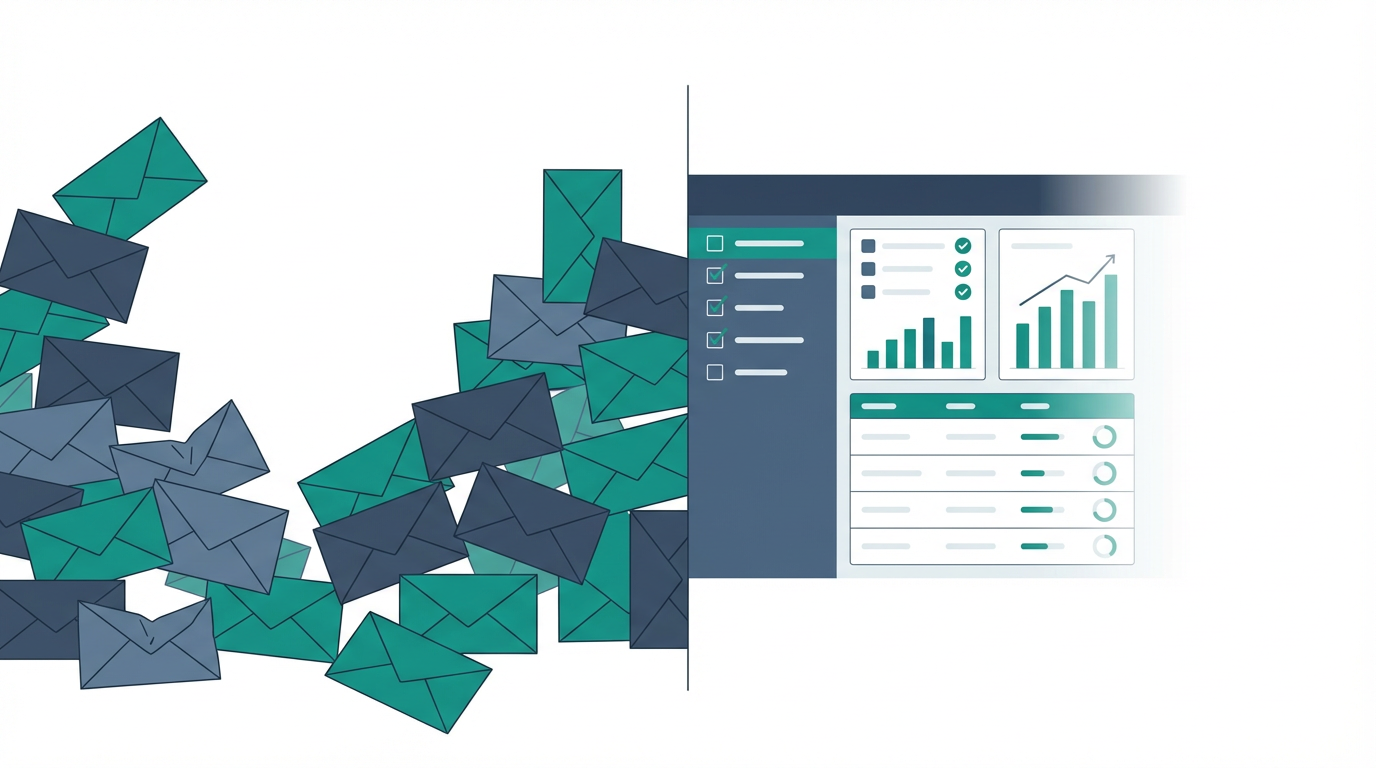
"Proactive AP" appears in enough conference presentations and vendor marketing decks that it's lost most of its meaning. The term has become a direction. "We should move in this direction" without a clear picture of what the destination looks like or what the specific steps are to get there.
Debra Richardson wrote a post a few years ago titled "If You Had to Wait for a Vendor to Notify You of a Fraudulent Payment" that made a pointed observation. In most AP departments, the first sign that something has gone wrong is a vendor telling you about it. The team didn't surface the problem. They received notification of it. That's reactive operations at its starkest.
This post attempts to give "proactive AP" operational definition in a healthcare context. Three specific shifts, each with a concrete description of what the reactive state looks like versus what proactive looks like in practice, and what's required to make the shift.
Shift 1: From Responding to Incoming to Monitoring What's About to Go Wrong#
The Reactive State#
A vendor emails asking why Invoice #78234 hasn't been paid. The AP rep opens the email, searches the ERP, and discovers the invoice has been on hold for three weeks because the goods receipt hasn't been processed. She contacts the receiving department, gets the receipt confirmed, processes the release, and responds to the vendor with an expected payment date.
From the AP team's perspective, this is a successful resolution. But from a workflow perspective, it was entirely vendor-driven. The invoice sat in a hold state for three weeks. Nobody in AP was watching it. The vendor noticed it on their aging report, emailed about it, and the AP team reacted.
The cost: the vendor is now 21 days older on this invoice. The early-pay discount window has long since closed. The vendor's AR team has already logged this account as slow-paying. And the AP rep spent 20 minutes on work that could have been done in five minutes if the hold had been caught and resolved in week one.
The Proactive State#
In a proactive AP operation, someone is reviewing invoices in hold status on a regular cadence. That someone is either a person or a systematic process. Any invoice that has been in hold status for more than a defined threshold (five business days is a reasonable starting point for supply chain-critical vendors) surfaces for review.
The AP rep or team lead sees the hold, understands the reason (missing goods receipt), contacts the receiving department proactively, and resolves the hold before the vendor notices. When the vendor's statement arrives, that invoice shows as paid or in-process rather than appearing as an unexplained aging balance.
What this requires: The ability to query the ERP for invoices by hold status and age without running a full manual lookup. Most Enterprise Resource Planning systems can generate aging hold reports. The question is whether the AP team has a workflow built around reviewing those reports regularly rather than waiting for vendor contact.
Shift 2: From One Email at a Time to Recognizing Patterns in Bulk#
The Reactive State#
On a given Tuesday, the AP inbox receives five separate emails. One is from a McKesson AR rep about Invoice #45219. One is from a different McKesson rep (different division, different billing entity) about Invoice #45891. Two more come in over the course of the day from other McKesson divisions about their own invoices. A fifth comes in on Wednesday from a McKesson collections supervisor referencing "several outstanding invoices."
In reactive mode, each of these is handled as a separate inquiry. Five separate ERP lookups. Five separate responses. No recognition that these five emails represent a pattern, a vendor relationship with multiple open items that probably warrants a consolidated response and possibly a relationship-level conversation.
When the collections supervisor's email arrives, the AP rep responds to it without the context of the four earlier emails from other divisions. The supervisor doesn't know what the AP team knows about the four invoices being in process. The AP team doesn't know what the supervisor knows about the collective urgency of the situation.
The Proactive State#
A proactive AP team tracks inquiry patterns, not just individual inquiries. When four emails arrive from different McKesson entities in a 48-hour window, that pattern triggers a different response than four unrelated vendor inquiries.
The proactive response is to step back and ask: what is the total McKesson position right now? Pull all open McKesson invoices across all entities from the ERP. Identify the ones approaching payment, the ones on hold, and any that are overdue. Draft a consolidated status communication covering all of them. One email to the right contact (ideally a McKesson account manager or senior AR contact rather than the individual division reps) that addresses the full picture.
This converts five separate reactive inquiry-response cycles into one proactive relationship-level communication. It reduces handle time, demonstrates AP competency to the vendor, and preempts the follow-up emails that would have come from the divisions whose invoices weren't individually addressed.
Vendor-level inquiry pattern tracking doesn't require sophisticated tooling. A simple rule: any vendor from whom the AP inbox receives three or more emails in a five-business-day window should trigger a consolidated ERP review and a proactive status update to a senior contact at that vendor. Most teams can implement this as a manual habit with a shared tracking list.
What this requires: The ability to look across all inquiries from a single vendor, across different email addresses, different billing entities, and different contact names, and see them as one vendor relationship rather than disconnected messages. This is a recognition challenge (identifying that different email domains belong to the same vendor) and a workflow challenge (having a process for consolidated vendor responses).
Shift 3: From Measuring What Was Processed to Measuring What Was Prevented#
The Reactive State#
At the end of the month, the AP team's performance is measured by what happened: how many invoices were processed, what the DPO was, how many exceptions were resolved. These are backward-looking metrics. They tell you what the team did.
What they don't tell you is what the team prevented. How many credit holds were averted because an invoice was resolved before the vendor escalated? How many early-pay discount windows were captured because a dispute was cleared in time? How many vendor escalations to procurement were headed off by a timely response?
In a reactive model, prevention isn't measured because prevention isn't a deliberate strategy. It happens occasionally, by accident, when an inquiry is answered quickly and the escalation that would have followed simply doesn't happen.
The Proactive State#
A proactive AP team tracks leading indicators alongside lagging indicators. The leading indicators are the ones that predict future problems: backlog age, hold invoice aging, vendor escalation early warning signals (repeated emails, tone changes in vendor communications, follow-up frequency).
The lagging indicators confirm whether prevention worked: credit holds issued (compared to historical baseline), early-pay discount capture rate (compared to prior periods), vendor escalation rate to procurement and management contacts.
A proactive team can look at month-end metrics and say: "We had zero credit holds this month compared to three last month. Our early-pay discount capture improved from 68% to 81%. Our escalation rate to procurement dropped by half." Those numbers tell a prevention story that justifies the process investment and makes the case for continued attention to proactive inquiry management.
What this requires: Tracking the KPIs from the measurement framework we covered earlier in this series, and specifically tracking them over time rather than as one-time snapshots. Month-over-month trend data on backlog age, escalation rate, and discount capture rate gives you the prevention story.
Why Vendor Portals Didn't Make AP Proactive#
Before discussing what does enable proactive AP operations, it's worth addressing what hasn't worked. Specifically, vendor self-service portals.
The pitch for vendor portals was appealing. If vendors could check invoice status themselves, AP teams would receive fewer inquiries and could get ahead of their work. Healthcare invoice portal adoption failure has been well documented. Adoption typically lands at 15 to 25% after twelve months, with the lowest rates among the large distributors who generate the most inquiry volume. McKesson, Cardinal Health, and Medline AR teams don't log into 200 hospital portals; they send emails.
But beyond the adoption problem, portals failed the proactive test even in environments where adoption was reasonable. A portal gives vendors self-service access to the same ERP data your AP team is already managing reactively. It doesn't give your team visibility into invoice holds or aging patterns. It doesn't surface at-risk vendor relationships before they escalate. Healthcare invoice portal adoption failure wasn't just a vendor behavior problem. It was a solution that addressed the wrong side of the equation.
The vendors who did adopt portals primarily used them to check invoice status, the same routine status inquiries that represent Tier 1 work under any SLA framework. The high-stakes Tier 2 and Tier 3 scenarios (credit hold risk, discrepancies, escalations) still arrived by email, still required ERP investigation, and still got handled reactively.
This matters for the reactive-to-proactive conversation because it clarifies what "proactive" actually requires. It's not about giving vendors a different channel. It's about giving your team the workflow and information infrastructure to surface problems before vendors surface them for you. Healthcare invoice portal adoption failure pointed the industry in the wrong direction for a decade. The shift that actually matters is internal, not vendor-facing.
Proactive AP Doesn't Happen Through Willpower#
There's an important honest acknowledgment to make about all three of these shifts: they cannot be achieved through effort and discipline alone if the underlying information problem isn't solved.
A rep who wants to monitor invoice holds proactively can't do it if generating a hold aging report from the ERP requires 20 minutes of manual navigation. A team that wants to recognize multi-entity vendor patterns can't do it if each email in the inbox appears as an isolated message with no vendor context attached. An AP director who wants to track prevention metrics can't do it if the only data available is the invoice processing data that lives in the ERP's standard reporting module.
The shift from reactive to proactive requires that the right information surface at the right time with minimal manual effort. This is a workflow and information design problem, not a motivation problem. Describing the operational difference between reactive and proactive is the starting point. The harder work is identifying what would need to be true about your information environment to make the proactive state achievable.
For many healthcare AP teams, the honest answer is that some of these shifts are partially achievable today with existing tools and some require capabilities that don't currently exist in their environment. Acknowledging that gap is more useful than motivating the team to work harder within a workflow that structurally prevents proactive operation.
It's worth being precise about where Robotic Process Automation (RPA) fits here. RPA does excellent work on structured, rule-based tasks. Pulling an aging hold report from Infor CloudSuite FSM on a schedule, exporting open invoice data from Workday Financial Management, dropping a CSV into a shared drive every morning, those are the kind of jobs RPA was built for, and a well-configured bot will run them reliably for years. The proactive monitoring shift sits one layer above that. The data inputs are predictable, but the judgment calls are not. A 35-day open invoice on a Cardinal Health record might be a missing goods receipt, a coding mismatch, a contract pricing variance, or a duplicate that was already paid under a different invoice number. Reading three vendor emails from different McKesson divisions and recognizing they describe the same underlying GPO contract issue is not a rule-based task. RPA is the right tool for surfacing the report. Something else has to read what's on it.
The goal of naming the destination clearly, what proactive AP looks like in specific operational terms, is to make it possible to evaluate the gap between where you are and where you could be, and to make deliberate decisions about which shifts to prioritize and what investments would enable them.
For more on the measurement infrastructure that enables proactive AP, specifically the KPIs that track prevention rather than just processing, see the five vendor inquiry KPIs framework. For the compliance dimension of proactive vendor communication, the audit trail post covers why documentation of vendor communication history matters as much as the communication itself.
See What Proactive Looks Like in Practice
Auxtri surfaces invoice holds, aging vendor inquiries, and credit hold risk signals automatically, so your AP team can act before vendors ask. Request a demo and we'll show you what the proactive vendor communication workflow looks like against your actual ERP data.